With thanks to the Quekett Microscopical Club. We thought your post was so great we wanted to share it with our readers. You can find our more about Quekett on their website.
They write…(Report and most photographs by Alan Wood)
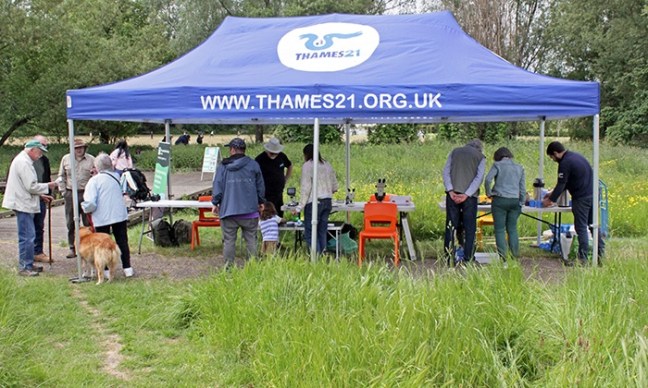
London Rivers Week is an annual event run by the environmental charity Thames21. As a contribution to London Rivers Week, CPRE London coordinated an event involving the Friends of Chinbrook Meadows, the Quaggy Waterways Action Group, the Chinbrook Action Residents Team, Glendale and the Quekett Microscopical Club – providing a free and family-friendly Nature Discovery Day.
As part of the Quekett’s microscopy outreach programme, Paul Smith and Alan Wood took along some simple battery-powered microscopes and some books and free leaflets so that parents and children could have a close look at specimens from the river and the plants in the meadow.
Thames21 brought along a large gazebo that they set up near the boardwalk, and the Quekett occupied one normal table and one low table with their microscopes and equipment.
The Friends of Chinbrook Meadows provided nets, trays, bottles and magnifiers so that families could collect specimens where the river runs under the boardwalk, and then take them for a closer look under the microscopes. They also provided waterproof versions of the Freshwater name trail from the Field Studies Council, to help identify the specimens.
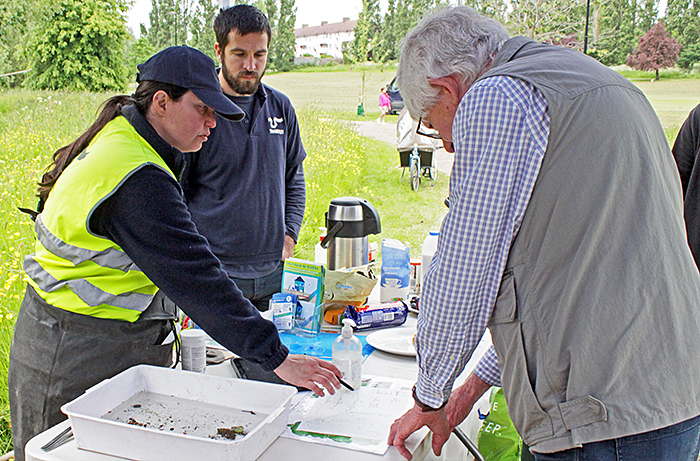
Alan Wood brought his Olympus SZ4045 stereomicroscope with a battery powered LED ring-light, a small stereomicroscope (the STX Stereo Microscope sold on Amazon by GT Vision) and a Natural History Museum Pocket Microscope. He used small plastic Petri dishes to hold specimens from the river, and a pipette or a tea spoon to transfer specimens. He also brought a copy of Collins Field Guide to Freshwater Life by R. Fitter & R. Manuel (the 1986 edition, very popular with Quekett members), and some free leaflets on using microscopes and observing pond life (available as PDFs from our Downloads page).
The specimens included lots of freshwater shrimps (Gammarus), several mayfly nymphs (Ephemeroptera), and a few freshwater lice (Asellus), bloodworms (larvae of non-biting midges, Chironomidae) and leeches. We also found one caddis larva (Trichoptera) in its case, and one damselfly nymph (Coenagrionidae).
All of the specimens were returned to the river when the event ended.
Carolina Pinto and Miguel Sanabria from Thames21 brought along some tea, coffee, biscuits and sandwiches, organised kick-sampling sessions in the Quaggy, and were kept busy explaining their plans to divert the river through a new wetland area that will filter the water to help remove pollutants and will be planted with waterside plants to provide an improved habitat for wildlife.
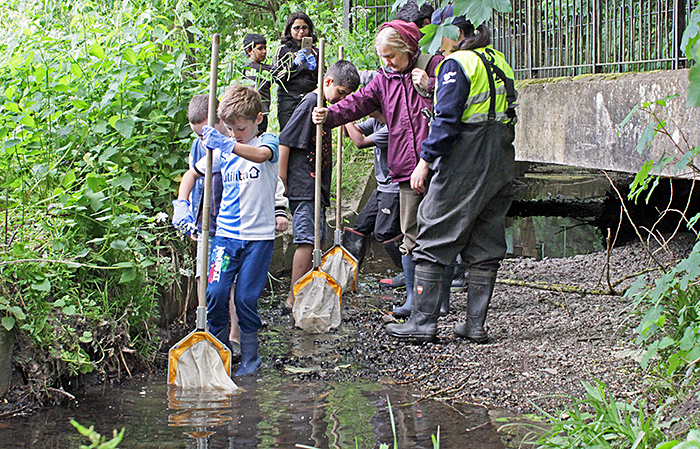
Carolina led two trips to the Quaggy to collect specimens using kick-sampling. Before taking the children down to the water, Carolina provided them with thin, blue rubber gloves and explained that they must not touch their eyes, mouth or face with wet hands.
Carolina showed the children how to hold the nets in the water and asked them to kick the bottom for 2 minutes so that specimens would be disturbed and the current would wash them into the net.
All of the specimens were returned to the river when the event ended.
Paul de Zylva from the Quaggy Waterways Action Group (QWAG) led a walk in the meadow during which he explained the history of the meadow and the river. He was kept busy explaining QWAG’s ambitious project to release the parts of the Quaggy that are still enclosed in concrete and make it possible to walk along or near the river from central Lewisham, through Greenwich and on to Grove Park.
We are looking forward to the next event at Chinbrook Meadows.
 Nature Conservation Lewisham